Lecture 3
Properties of Probability and Finite Spaces
Grace Tompkins
Last modified — 23 Oct 2026
Today’s Learning Outcomes
By the end of this lecture, students are anticipated to be able to
- Prove four properties of the probability function
- Apply the properties to word problems
- Calculate probabilities of finite sample spaces
- Apply to multiplicative principle
Properties of the Probability Function
Let \(A\) and \(B\) denote arbitrary events, where \(\Omega\) is the sample space.
- Probability of the complement: \(\mathbb{P}( A^{c} ) =1-\mathbb{P}( A )\)
- Monotonicity: \(A\subset B\Rightarrow \mathbb{P}( A ) \leq \mathbb{P}(B )\)
- Probability of the union: \(\mathbb{P}( A\cup B ) =\mathbb{P}( A ) +\mathbb{P}( B ) - \mathbb{P}( A\cap B )\)
- Boole’s inequality: \(\mathbb{P}( \bigcup _{i=1}^{m}A_{i} ) \leq \sum_{i=1}^{m}\mathbb{P}( A_{i} )\)
Properties of the Probability Function
Prove the probability of the complement: \(\mathbb{P}( A^{c} ) =1-\mathbb{P}( A )\).
To do this, show that if \(\mathbb{P}\) satisfies Axioms 1, 2, and 3, and \(A\) is an arbitrary event, then necessarily \(\mathbb{P}( A^{c} ) \ = \ 1-\mathbb{P}( A )\).
Hint: What is \(A \cup A^c\)?
Properties of the Probability Function
Properties of the Probability Function
Prove monotonicity: \(A\subset B\Rightarrow \mathbb{P}( A ) \leq \mathbb{P}(B )\)
Hints:
- Show \(B = ( B\cap A ) \cup ( B\cap A^{c})\);
- You can use the fact that if \(A \subset B\), then \(A \cap B = A\).
- Since we know that \(A \subset B\), then \(B \cap A = A\)
Properties of the Probability Function
Properties of the Probability Function
Properties of the Probability Function
Prove the probability of the union: \(\mathbb{P}( A\cup B ) =\mathbb{P}( A ) +\mathbb{P}( B ) - \mathbb{P}( A\cap B )\)
Hint: First prove that \(A\cup B = A\cup ( B\cap A^{c} )\)
Properties of the Probability Function
Properties of the Probability Function
Properties of the Probability Function
Prove Boole’s inequality: \(\mathbb{P}( \bigcup _{i=1}^{m}A_{i} ) \leq \sum_{i=1}^{m}\mathbb{P}( A_{i} )\)
Properties of the Probability Function
Applying Boole’s
Suppose that \(\mathbb{P}\left( A\right) =0.85\) and \(\mathbb{P}\left( B\right) =0.75.\) Show that \[\mathbb{P}\left( A\cap B\right) \geq 0.60.\]
Example
Marley borrows 2 books. Suppose that there is a 0.5 probability they like the first book, 0.4 that they like the second book, and 0.3 that they like both.
What is the probability that they will NOT like both books? (i.e. that they will not like either book?)
1 Uniform Probability on Finite Spaces
Finite and Equally Likely Outcomes
When there are finitely many outcomes, and they are equal likely, calculating probabilities involves counting outcomes in events/sets,
Let \(A\) be a subset (event) of a sample space \(\Omega\).
\[ \mathbb{P}\left( A\right) = \frac{\text{number of elements in }A}{\text{number of elements in }\Omega } \]
Finite and Equally Likely Outcomes
- Experiment: roll a fair die;
- Sample space: \(\Omega = \{1, 2, 3, 4, 5, 6\}\).
- If the die is fair we have \[\mathbb{P}(\{1\}) = \mathbb{P}(\{2\}) = \cdots = \mathbb{P}(\{6\})\]
We have 6 possible outcomes, all equally likely.
Therefore the probability of rolling a any single number is \(1/6\).
Finite and Equally Likely Outcomes
Suppose that we flip three different fair coins. What is the probability of rolling three heads in a row?
Finite and Equally Likely Outcomes
When the number of possible events are small, solving problems in this way is straightforward.
However: counting the number possible events can be challenging, particularly as the number of possible events increases
- Imagine rolling flipping 10 coins in a row. Writing out the sample space would be unreasonablly long
We will introduce permutations and combinations briefly to overcome this issue
- These provide ways to count the number of possible events
Counting Sequences: Multiplicative Principle
If a random experiment has k steps.
- Step 1 has \(n_1\) possible outcomes,
- Step 2 has \(n_2\) possible outcomes,
\(\quad\quad\quad\vdots\quad\quad\quad\)
- Step k has \(n_k\) possible outcomes.
Then, \[\mbox{total number of outcomes} \ = \ n_1 \times n_2 \times n_3 \times \cdots \times n_k\]
Note
Implicit assumption: the outcomes of each step do not depend on each other.
Counting Sequences: Multiplicative Principle
Suppose that we flip three different fair coins. Without writing out the sample space, can you calculate the probability of rolling a head, a tail, and then a head?
Counting Sequences: Multiplicative Principle
What is the probability of drawing 5 cards in a row that are all clubs? Assume any card you picked is put back into the deck and shuffled before every draw.
2 Combinations
Combinations
Combination (of size \(m\)): a subset of \(m\) items from a set of size \(n\) (where necessarily \(m\) \(\leq\) \(n\)).
Note: We only care which elements are in the set, not the ordering.
Consider the set \[S=\left\{ a, b, c, d, e\right\}\]
The following are all the possible subsets of \(S\) of size 3:
| \(\{ a, b, c\}\) | \(\left\{ a, d, e\right\}\) |
| \(\{ a, b, d\}\) | \(\left\{ b, c, d\right\}\) |
| \(\{ a, b, e\}\) | \(\left\{ b, c, e\right\}\) |
| \(\{ a, c, d\}\) | \(\left\{ b, d, e\right\}\) |
| \(\{ a, c, e\}\) | \(\left\{ c, d, e\right\}\) |
Combinations
- Note that the order of the elements does not matter (these are sets, not sequences).
\[ \Bigl\{ a, b, d \Bigr\} \, = \, \Bigl\{ d, a, b \Bigr\} \, = \, \Bigl\{ b, d, a \Bigr\} \] (and other possible rearrangements).
Combinations
A useful mathematical property is the factorial.
Factorial (!):
For any non-negative integer \(n\):
\[ n! = n \times(n-1)\times(n-2)\times(n-3)...3\times2\times1 \] and
\[ 0! = 1 \]
Number of Combinations
The number of combinations of size \(m\) out of a set of size \(n \ge m\) has various notations:
\[\binom{n}{m} = \left._{n} C_{m}\right. = C_m^n = \frac{n!}{m!(n-m)!}\]
- \(n\): size of the set from which combinations are drawn
- \(m\): size of the combinations
- we read it as “n choose m”
Tip
In this course we use \(\binom{n}{m}\).
Example
There are five friends (\(\{A, B, C, D, E\}\)), and three concert tickets. How many different combinations of people can attend the concert?
Here, \(n=5\) and \(m=3\) we have
| \(\{ A,B,C\}\) | \(\left\{ A,D,E\right\}\) |
| \(\{ A,B,D\}\) | \(\left\{ B,C,D\right\}\) |
| \(\{ A,B,E\}\) | \(\left\{ B,C,E\right\}\) |
| \(\{ A,C,D\}\) | \(\left\{ B,D,E\right\}\) |
| \(\{ A,C,E\}\) | \(\left\{ C,D,E\right\}\) |
hence, the number of combinations must be
\[\binom{5}{3}= {10}\]
General formula
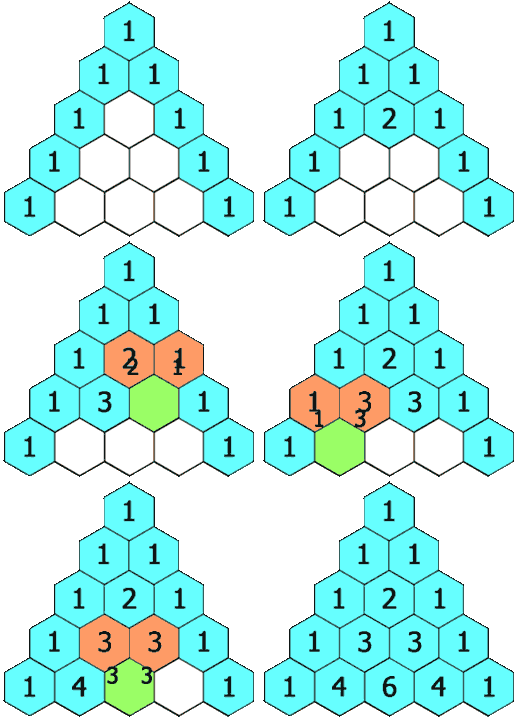
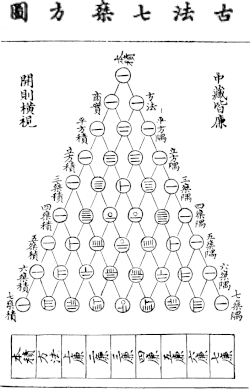
\[\binom{n}{m} = \frac{n!}{m!(n-m)!}\] are also called binomial coefficients.
They have many beautiful interpretations.
Checkpoint 1 is next week!
Your first checkpoint (one short question at the end of class ~ 15 minutes) is on Friday September 25th.
It is a small closed-book assessment based on the practice problems assigned for Sections 1.1 - 1.4 (all material so far up to the end of this lecture)
You may bring a non-graphing, non-programmable calculator and one cheat sheet, which you should add/edit to over time for all assessments. Cheat sheet rules:
- Must be 8.5 x 11 inches or smaller
- Can write on both sides
- MUST BE HANDWRITTEN, not photocopied or printed (not typed nor drawn on tablet)
- Write whatever you want on it
Cheat sheets and calculators that do not follow these rules will be confiscated - sorry!
CFA Students
CFA students: you may choose to leave class when the quiz begins to write in the CFA, or you are welcome to stay in class to write.
It is your responsibility to book EVERY CHECKPOINT, midterm, and final exam with the CFA. We do not have enough spaces/resources/TAs to provide accommodations in class, including extra time. There is a class directly after this one.
Stat 302 - Winter 2025/26