Lecture 7
Discrete Random Variables (Part 1)
Grace Tompkins
Last modified — 23 Oct 2026
Learning Outcomes
By the end of this lecture, students are anticipated to be able to:
Identify discrete distributions
Use the Bernoulli and binomial distributions to solve for probabilities
1 Discrete Random Variables
Discrete Random Variables
We say that a random variable \(X\) is discrete if there exists a countable set \(K = \{x_1,x_2,\dots\}\) such that
\[\mathbb{P}(X \in K) = 1.\]
- In particular, this means that \(\{x : P(X=x)>0\}\) is countable:
I can count the \(x\) that have positive probability.
- For discrete RVs, we call the set \(\{x : P(X=x) > 0\}\) the support of \(X\).
Examples of Experiments Described by Discrete Random Variables
Toss a fair coin 3 times, count the total number of Heads.
Roll a 6-sided die until you see 6, count the number of rolls.
Count the number of people that arrive at the bus stop in some amount of time.
Will it be rainy (\(-6\)), cloudy (2), or sunny (\(+10\)) on campus today?
Probability Mass Function (PMF)
- For discrete random variables, we can be explicit about the probability associated with each value in it’s support
For a discrete random variable, its probability (mass) function is the function \(p_X : {\mathbb{R}}\rightarrow [0,1]\) defined by \[p_X(x) = \mathbb{P}(X = x).\]
It is occasionally written \(f_X(x) = \mathbb{P}(X = x).\)
- Each of the examples of discrete random variables has a PMF. Once we write it down, we know everything there is to know.
A Rainy Day
Suppose it rains 30% of the time, is cloudy but not raining 30% of the time, and sunny 40% of the time.
Your happiness is given by the random variable \(Z\) with \(Z=-6, 2,\) and 10 respectively.
What is the support of \(Z\)?
What is the PMF of \(Z\)?
A Rainy Day
Fair Coins
Toss a fair coin 3 times. Let \(X\) be the number of heads.
- What is the support of \(X\)?
- What is the \(p_X(x)\)?
Finding Probabilities of Events
The PMF can be used to find the probabilities of events.
We have that for some event \(A\) and a RV \(X\),
\[\mathbb{P}(X \in A) = \sum_{x \in A} p_X(x).\]
Recall: it rains 30% of the time, is cloudy but not raining 30% of the time, and sunny 40% of the time. Your happiness is given by the random variable \(Z\) with \(Z=-6, 2,\) and 10 respectively.
- Let \(A\) be the event that you are happier than 0. Find \(\mathbb{P}(Z \in A)\).
Another PMF
For a fixed number \(\theta \in [0, 1]\), define a discrete random variable \(X\) with PMF given by:
\[ p_X\left( x;\ \theta\right) =\begin{cases} \left( 1-\theta\right) ^{2} & x=0, \\ 2\theta\left( 1-\theta\right) & x=1, \\ \theta^{2} & x=2, \\ 0 & \mbox{else.} \end{cases} \]
- Different values of \(\theta\) will give different PMFs.
\[ p_X\left( x;\ \theta = 0.1\right) =\begin{cases} 0.81 & x=0, \\ 0.18 & x=1, \\ 0.01 & x=2 \\ 0 & \mbox{else.} \end{cases} \]
By including a parameter \(\theta\), we are able to express many distributions (a family of distributions) with a single functional form.
2 Discrete families
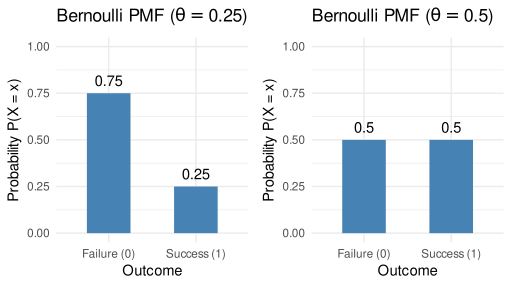
Bernoulli
An experiment with 2 outcomes (success/failure).
Suppose the probability of success is \(\theta \in (0,1)\). A RV \(X\) with PMF given by
\[p_X(x; \theta) = \theta^x(1-\theta)^{1-x}I_{\{0,1\}}(x),\]
is said to have the \({\mathrm{Bern}}(\theta)\) distribution.
If \(\theta = 0.5\), then we have our favourite fair-coin friend.
But we can let \(\theta\) be numbers other than 0.5.
Bernoulli
Binomial
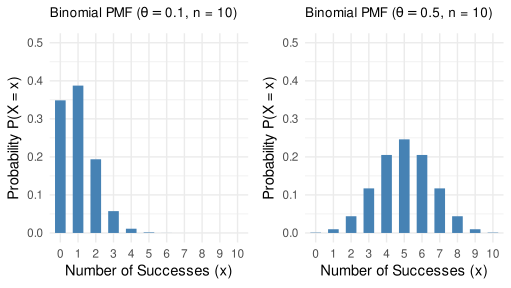
Used to determine the number of “successes” (\(x\)) in a sequence of \(n\) independent Bernoulli trials, each with the same probability of success (\(\theta\)).
Suppose the probability of success is \(\theta \in (0,1)\). A RV \(X\) with PMF given by
\[p_X(x; n, \theta) = \binom{n}{x} \theta^x (1-\theta)^{n-x}I_{\{0,1,\dots,n\}}(x),\]
is said to have the \({\mathrm{Binom}}(n, \theta)\) distribution.
Binomial
Using the Binomial
\[p_X(x; n, \theta) = \binom{n}{x} \theta^x (1-\theta)^{n-x}I_{\{0,1,\dots,n\}}(x)\]
- Suppose Midterm 1 has 5 True/False questions. What is the probability that you get at least 4 correct answers by random guessing?
- Suppose Midterm 1 has 2 multiple choice questions with 5 options. What is the probability that you get both correct by random guessing?
Using the Binomial
Checkpoint 2
You may have:
HANDWRITTEN Cheat Sheet
Non-graphing calculator
Writing materials
Phones and laptops put away, please! You can have 15 minutes.
Stat 302 - Winter 2025/26