Lecture 12
Cumulative Distribution Functions
Grace Tompkins
Last modified — 23 Oct 2026
Learning Outcomes
By the end of this lecture, students are anticipated to be able to:
- Define a CDF
- Use a CDF to calculate cumulative probabilities
- Convert between PDFs and CDFs
- Find Mixture Distributions
1 Cumulative Distribution Functions (CDFs)
Cumulative Distribution Functions (CDFs)
The cumulative distribution function of a random variable \(X\) is \[F_X(x) \, = \, \mathbb{P}\left( X \le x \right) \, , \qquad \mbox{ for } x \in {\mathbb{R}}\]
Let \(X\) be a random variable with CDF \(F_X\). Then:
- \(0 \le F_X(x) \le 1\) for all \(x \in {\mathbb{R}}\);
- \(F\left( x \right) \leq F(y)\) for all \(x \leq y\);
- \(\lim_{a \to -\infty} F_X\left( a \right) =0\),
- \(\lim_{a \to +\infty} F_X\left( a \right) =1\)
CDFs for Discrete and Continuous RVs
Discrete RV
\[F_X(x) = \sum_{t \leq x} p_X(t)\]
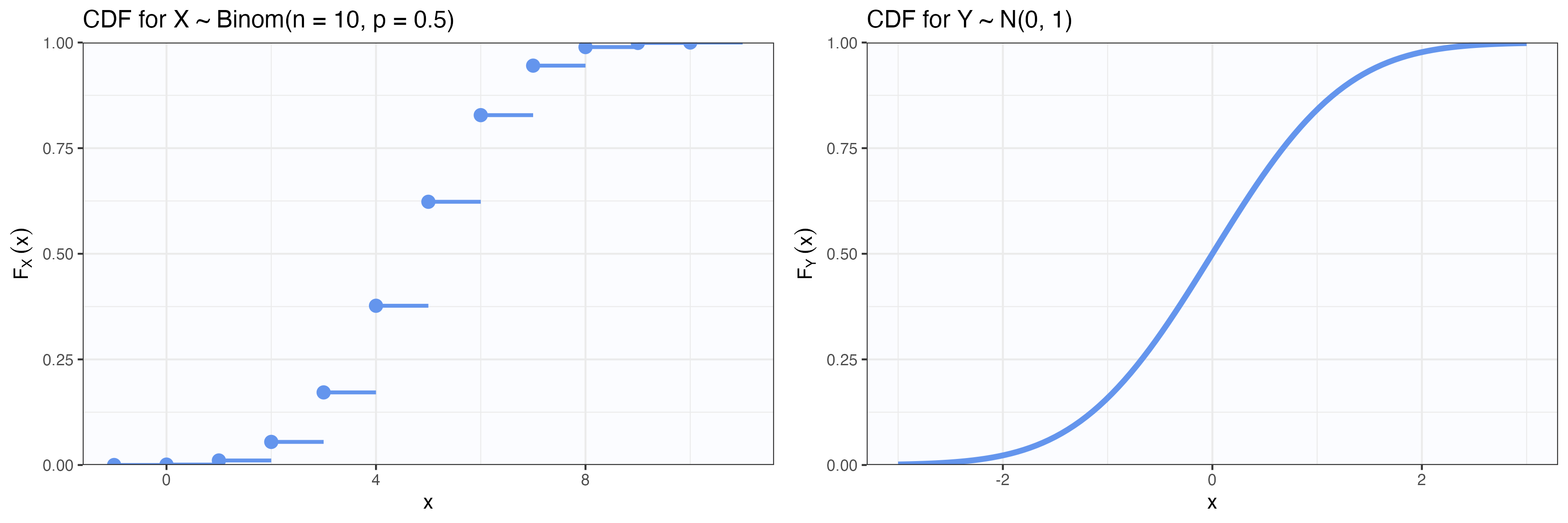
- The CDF is a step function and right-continuous.
Continuous RV
\[F_X(x) = \int_{-\infty}^x f_X(t) \mathsf{d}t\]
- The CDF is continuous (left and right limits are equal).
Continuous CDF Example
Let \(X \sim {\mathrm{Exp}}(\lambda)\), with pdf \[f_X(x) = \lambda e^{-\lambda x} I_{[0,\infty)}(x).\]
Find \(F_{X}\left(x \right)\). Use the CDF to calculate \(\mathbb{P}(x \le 10)\) when \(\lambda = 1/5\).
Continuous CDF Example
Discrete CDF Example
Consider rolling one fair six-sided die, so that \(\Omega = \{1, 2, 3, 4, 5, 6\}\), with \(\mathbb{P}(\omega) = 1/6\) for each \(\omega \in \Omega\) Let \(X\) be the number showing on the die. What is \(F_{X}(x)\)? Use this to find \(\mathbb{P}(X \le 5)\).
CDFs and Distributions
Let \(X\) be any random variable with CDF \(F_X\). Let \(B\) be any subset of \({\mathbb{R}}\). Then \(\mathbb{P}(X \in B)\) can be determined solely from \(F_X\).
- The CDF contains all the information about the distribution of \(X\).
- It doesn’t matter whether \(X\) is discrete, continuous, or anything else.
CDFs and Distributions
Let \(X\) be an absolutely continuous random variable with cumulative distribution function \(F_X\). Let
\[ f_X(x) = \frac{d}{dx}F_X(x) = F'(x). \] Then, \(f(x)\) is the density function for \(X\).
Aside: The discrete case involves finding the differences between consecutive CDF values.
CDFs and Distributions
Suppose a continuous RV has CDF:
\[ F_X(x) = \begin{cases} 0 & x < 0\\ x^2 & 0 \le x \le 1\\ 1 & x>1 \end{cases} \]
What is \(\mathbb{P}(X \le 0.75)\)?
Find the PDF \(f_X(x)\).
CDFs and Distributions
CDFs and Distributions
Suppose a discrete RV has CDF:
\[ F_X(x) = \begin{cases} 0 & x < 1 \\ 0.1 & 1 \le x < 2 \\ 0.35 & 2 \le x < 3 \\ 0.7 & 3 \le x < 4 \\ 1 & x \ge 4 \end{cases} \]
What is \(\mathbb{P}(X \le 3.5)\)?
Find the PDF \(f_X(x)\).
CDFs and Distributions
Mixture Distributions
Let \(X_1, X_2,\dots\) be a random variables with CDFs \(F_{X_1}, F_{X_2}, \dots\).
For any constants \(p_i\) such that \(p_i \ge 0\) and \(\sum_{i = 1}^k p_i = 1\), \(F_G(x) = \sum_{i = 1}^k p_i F_{X_i}(x)\) is the CDF of the mixture of \(F_{X_i}\).
Mixture Distributions
Suppose a bag contains two coins. You choose one at random and flip it once. Let \(X\) be the number of heads.
Coin A is a fair coin, with \(\mathbb{P}(\text{flip Heads}) = 0.5\) Coin B is a loaded coin, with \(\mathbb{P}(\text{flip Heads}) = 0.9\)
Write out the CDF for the number of heads flipped.
Mixture Distributions
Mixture Distributions
Consider the scores of a midterm. Suppose that there are three types of students, modeled as follows:
- Poorly prepared students who did not study much (30%): \(X_1 \sim \mathcal{N}(\mu = 50, \sigma = 10)\).
- Well prepared students who studied a lot (60%): \(X_2 \sim \mathcal{N}(\mu = 80, \sigma = 8)\).
- Students who didn’t take the exam at all (10%): \(X_3 = 0\) with probability 1.
Find the CDF of the overall score distribution \(X\). Write your answer in terms of the standard normal CDF \(\Phi(\cdot)\).
Hint: If \(Y \sim \mathcal{N}(\mu, \sigma)\), then \(F_Y(y) = \Phi\left( \frac{y - \mu}{\sigma} \right)\).
Mixture Distributions
Upcoming Assessments:
Checkpoint 4 (Sections 2.5 - 2.6: Continuous RV and CDFs) is on Friday Oct 30th
Checkpoint 5 (Sections 2.7 - 2.8: Joint, Marginal, and Conditional Distributions) is on Friday Nov 6th
Stat 302 - Winter 2025/26