Module 06
Normal distribution, CDFs, transformations, and joint distributions
TC and DJM
Last modified — 21 Apr 2026
1 Kernel matching and Gaussian distribution
Kernel and integration constant (review)
\[\begin{aligned} f_Z(z; \alpha, \lambda) &= \frac{\lambda^\alpha}{\Gamma(\alpha)} z^{\alpha-1}e^{-\lambda z} I_{[0,\infty)}(z). \end{aligned}\]
- PDFs/PMFs must integrate/sum to 1.
- The functional form can be thought of as two pieces:
- The “kernel” is the portion that depends on the argument (\(x\) or \(z\))
- The “normalizing constant” is the part that depends only on parameters; this makes the function integrate to 1.
- The support (given by the indicator function) is part of the kernel.
Kernel and integration constant: Example
\[f_Z(z; \alpha, \lambda) = \frac{\lambda^\alpha}{\Gamma(\alpha)} z^{\alpha-1}e^{-\lambda z} I_{[0,\infty)}(z)\]
- The kernel is \(z^{\alpha}e^{-\lambda z} I_{[0,\infty)}(z)\).
- The normalizing constant is \(\lambda^\alpha / \Gamma(\alpha)\).
We know that \[1 = \int_0^\infty \frac{\lambda^\alpha}{\Gamma(\alpha)} z^{\alpha-1}e^{-\lambda z} \mathsf{d}z \Longrightarrow \frac{\Gamma(\alpha)}{\lambda^\alpha} = \int_0^\infty z^{\alpha-1}e^{-\lambda z} \mathsf{d}z.\]
Kernel matching
\[f_Z(z; \alpha, \lambda) = \frac{\lambda^\alpha}{\Gamma(\alpha)} z^{\alpha-1}e^{-\lambda z} I_{[0,\infty)}(z)\]
Exercise 1
- What is \[\int_0^\infty z^3 e^{-5z} \mathsf{d}z?\]
- What is \[\int_0^\infty z \frac{\lambda^4}{\Gamma(4)} z^{3}e^{-\lambda z} \mathsf{d}z?\]
Hint: Recall that \(\Gamma(n) = (n-1)!\) when \(n \in \{1,2,\dots\}\).
The Normal (Gaussian) distribution
Definition
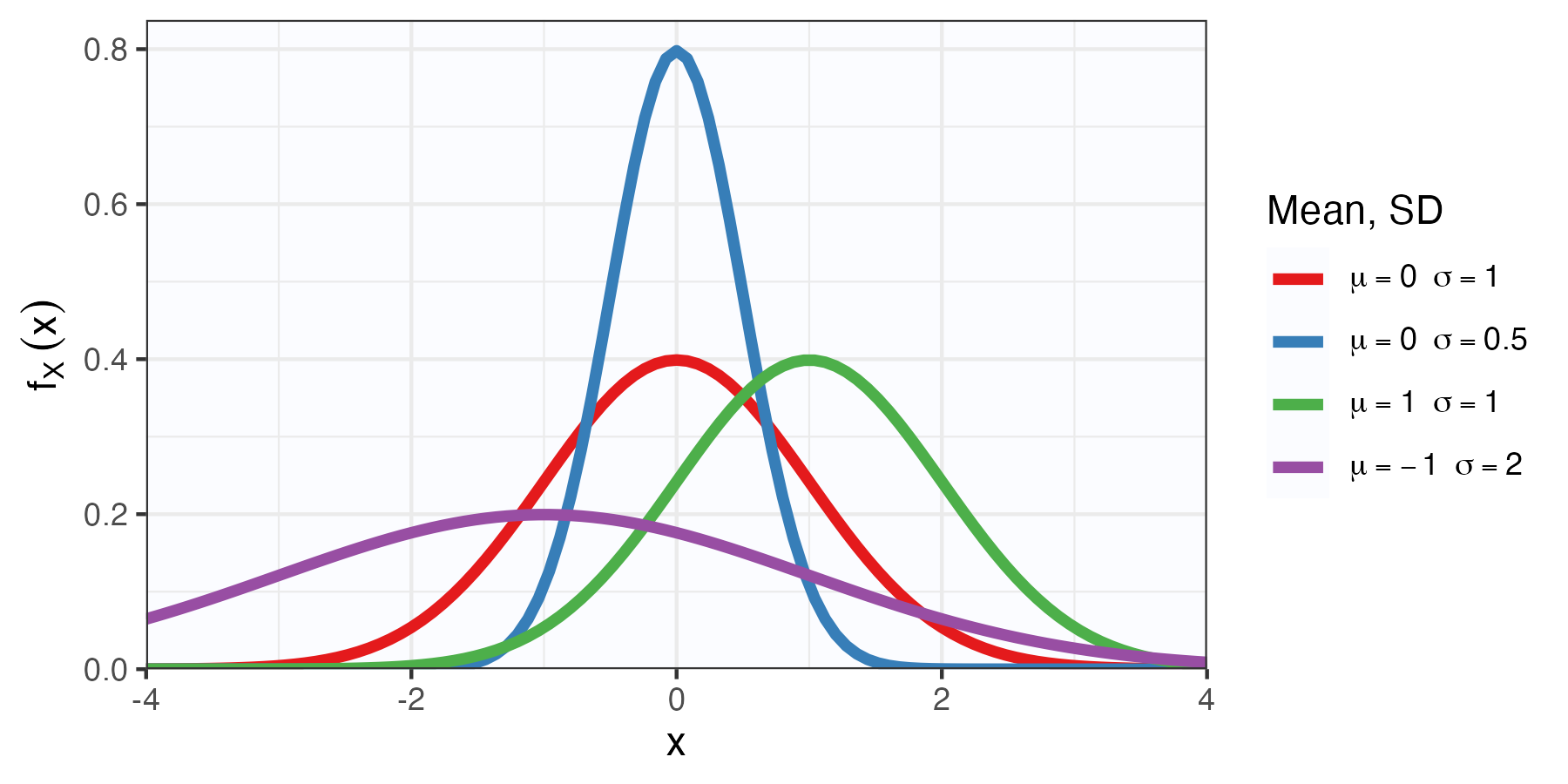
The Normal distribution, factoids
- This distribution is incredibly important.
- The reason is that it is good for modelling averages. We’ll justify this rigorously later.
- \(Z \sim \mathcal{N}(0,1)\) is called the standard normal distribution. When \(Z\) is written without context, it is often understood to have this specific distribution.
- Unfortunately \[\mathbb{P}(a<Z<b) = \int_a^b \frac{1}{\sqrt{2\pi}} e^{-z^2/ 2} \mathsf{d}z,\] does not have a closed form solution.
- Old folks used tables in textbooks to calculate this (Table D.2 on p. 712 for you).
- Nowadays, we use software.
2 Cumulative distribution functions (CDFs)
Cumulative distribution functions (CDFs)
Definition
Theorem
Let \(X\) be a random variable with CDF \(F_X\). Then:
- \(0 \le F_X(x) \le 1\) for all \(x \in {\mathbb{R}}\);
- \(F\left( x \right) \leq F(y)\) for all \(x \leq y\);
- \(\lim_{a \to -\infty} F_X\left( a \right) =0\),
- \(\lim_{a \to +\infty} F_X\left( a \right) =1\)
CDFs for discrete and continuous RVs
Discrete RV
\[F_X(x) = \sum_{t \leq x} p_X(t)\]
- The CDF is a step function and right-continuous.
Continuous RV
\[F_X(x) = \int_{-\infty}^x f_X(t) \mathsf{d}t\]
- The CDF is continuous (left and right limits are equal).
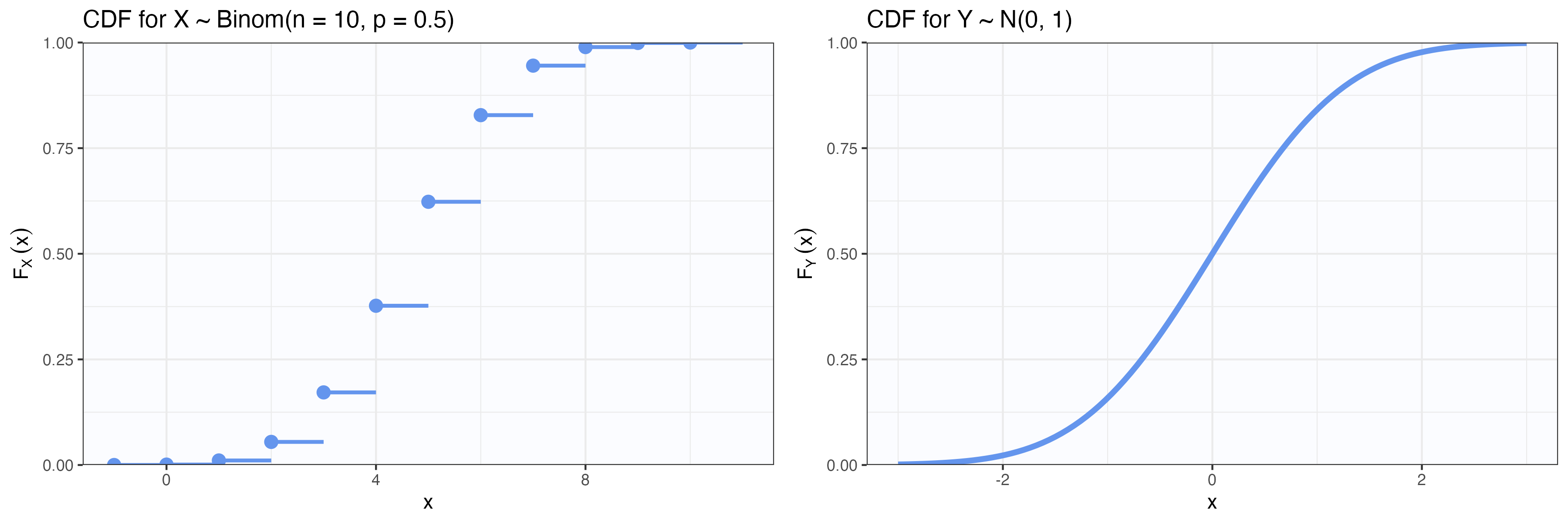
CDFs and distributions
Theorem
- This is a very important result.
- It means that the CDF contains all the information about the distribution of \(X\).
- It doesn’t matter whether \(X\) is discrete, continuous, or anything else.
- So the CDF “tells the whole story” about the distribution of \(X\).
CDF of \({\mathrm{Exp}}(\lambda)\)
Let \(X \sim {\mathrm{Exp}}(\lambda)\), with pdf \[f_X(x) = \lambda e^{-\lambda x} I_{[0,\infty)}(x).\]
Exercise 2
Using CDFs to create new distributions
Proposition
Let \(X_1, X_2,\dots\) be a random variables with CDFs \(F_{X_1}, F_{X_2}, \dots\). Then the the following hold:
- The RV \(Y = X_1 + c\) has CDF \(F_{X_1}(x - c)\);
- The RV \(Y = kX_1\) has CDF \(F_{X_1}(x/k)\) for any \(k > 0\);
- For any constants \(p_i\) such that \(p_i \ge
0\) and \(\sum_{i = 1}^k p_i = 1\), \(F_G(x) = \sum_{i = 1}^k p_i
F_{X_i}(x)\) is the CDF of the mixture of \(F_{X_i}\).
- There are various other similar results we could state.
- One may mix discrete and continuous distributions using CDFs.
Mixture distributions
Consider the scores on Midterm 1 in a class. Suppose that there are three types of students, modelled as follows:
- Poorly prepared students who did not study much (30%): \(X_1 \sim \mathcal{N}(\mu = 50, \sigma = 10)\).
- Well prepared students who studied a lot (60%): \(X_2 \sim \mathcal{N}(\mu = 80, \sigma = 8)\).
- Students who didn’t take the exam at all (10%): \(X_3 = 0\) with probability 1.
Exercise 3
Hint: If \(Y \sim \mathcal{N}(\mu, \sigma)\), then \(F_Y(y) = \Phi\left( \frac{y - \mu}{\sigma} \right)\).
3 Transformations of random variables
Transformations of a random variable
Let \(X\) be a random variable with some distribution, and let \(Y = g(X)\) for some function \(g : {\mathbb{R}}\to {\mathbb{R}}\).
We want to find the distribution of \(Y\).
- The “Distribution method” just uses the definition:
\[\mathbb{P}(Y \in A) = \mathbb{P}(g(X) \in A) = \mathbb{P}(\{x : g(x) \in A\}).\]
If we can characterize these sets, we can find the distribution of \(Y\). This method always works, and is easy for discrete random variables.
Theorem
Easy example of distribution method for discrete RVs
- Let \(X \sim {\mathrm{Binom}}(n, \theta)\), for some \(\theta \in (0,1)\).
- Let \(Y = n - X\).
Find the PMF of \(Y\).
We have that \[\begin{aligned} p_Y(y) &= \sum_{x : g(x) = y} p_X(x) = \sum_{x : n - x = y} p_X(x) \\ &= p_X(n - y) & \text{only one $x$ satisfies this}\\ &= \binom{n}{n - y} \theta^{n - y} (1 - \theta)^{y}I_{\{0,\dots,n\}}(n-y) & \text{definition of Binomial}\\ &= \binom{n}{y} (1 - \theta)^{y} \theta^{n - y}I_{\{0,\dots,n\}}(y) & \text{symmetry of binomial coeff.} \end{aligned}\]
Therefore, \(Y \sim {\mathrm{Binom}}(n, 1 - \theta).\)
Transformations of continuous random variables
For continuous random variables, you can also use the distribution method, and sometimes this is the easiest way.
- The other common method is the “Jacobian method”
Theorem
Example using the Jacobian method
- Let \(X \sim {\mathrm{Unif}}(0,1)\).
- Let \(Y = -\log(X)\).
Find the PDF of \(Y\).
Note that \(h(x) = -\log(x)\) is monotonic on \((0,1)\), so we can use the Jacobian method. The support of \(X\) is \((0,1)\), so \(Y\) takes values in \((0, \infty)\).
We have that \(h^{-1}(z) = e^{-z}\) and \(\frac{\mathsf{d}}{\mathsf{d}z} h^{-1}(z) = -e^{-z}\).
\[\begin{aligned} f_Y(y) &= f_X(h^{-1}(y)) \left| \frac{\mathsf{d}}{\mathsf{d}y} (h^{-1}(y)) \right|\\ &= f_X(e^{-y}) \left| -e^{-y} \right| \\ &= 1 \times e^{-y} I_{(0, \infty)}(y). \end{aligned}\]
Therefore, \(Y \sim {\mathrm{Exp}}(1)\).
Some transformations to practice
Exercise 4
Let \(X \sim {\mathrm{Unif}}\left( -1,1\right)\). Use the distribution method to find the PDF of \(Z = X^2\).
Let \(X \sim {\mathrm{Gam}}(\alpha, \lambda)\). Use the Jacobian method to find the PDF of \(Y = 1/X\).
- Gamma PDF
- \[f_X(x) = \frac{\lambda^\alpha}{\Gamma(\alpha)} x^{\alpha - 1} e^{-\lambda x} I_{(0, \infty)}(x).\]
- Jacobian method
- If \(X\) is continuous random variable, with density function \(f_X\), and \(Y = h(X)\), where \(h : {\mathbb{R}}\to {\mathbb{R}}\)is differentiable and, then \(Y\) is also absolutely continuous has PDF \[f_Y(y) = f_X(h^{-1}(y)) \left| \frac{\mathsf{d}}{\mathsf{d}y} (h^{-1}(y)) \right|.\]
4 Joint distributions
Joint distribution of several random variables
- Suppose \(X\) and \(Y\) are two random variables.
- We may be interested in their distributions separately.
- But this ignores the relationship between \(X\) and \(Y\).
Definition
Recall: \[\left\{ X \le a \, , \ Y \le b \right\} = \left\{ X \le a \right\} \cap \left\{ Y \le b \right\}.\]
Joint PMFs and PDFs
Let \(X\) and \(Y\) be two random variables with joint CDF \(F_{X, Y}(x, y)\).
Definition
Definition
Easy discrete example
- Consider the experiment of rolling two fair dice.
- Let \(X\) be the lowest of the two rolls, \(Y\) be the highest.
Find the joint PMF of \(X\) and \(Y\).
| \(f_{X,Y}(x, y)\) | 1 | 2 | 3 | 4 | 5 | 6 |
|---|---|---|---|---|---|---|
| 1 | 1/36 | 2/36 | 2/36 | 2/36 | 2/36 | 2/36 |
| 2 | 0 | 1/36 | 2/36 | 2/36 | 2/36 | 2/36 |
| 3 | 0 | 0 | 1/36 | 2/36 | 2/36 | 2/36 |
| 4 | 0 | 0 | 0 | 1/36 | 2/36 | 2/36 |
| 5 | 0 | 0 | 0 | 0 | 1/36 | 2/36 |
| 6 | 0 | 0 | 0 | 0 | 0 | 1/36 |
Marginal CDFs
Theorem
Definition
Marginal PMFs and PDFs
Theorem
Theorem
Important
All of this generalizes to more than two random variables.
Easy discrete example, continued
- Consider the experiment of rolling two fair dice. Let \(X\) be the lowest of the two rolls, \(Y\) be the highest.
| \(f_{X,Y}(x, y)\) | 1 | 2 | 3 | 4 | 5 | 6 |
|---|---|---|---|---|---|---|
| 1 | 1/36 | 2/36 | 2/36 | 2/36 | 2/36 | 2/36 |
| 2 | 0 | 1/36 | 2/36 | 2/36 | 2/36 | 2/36 |
| 3 | 0 | 0 | 1/36 | 2/36 | 2/36 | 2/36 |
| 4 | 0 | 0 | 0 | 1/36 | 2/36 | 2/36 |
| 5 | 0 | 0 | 0 | 0 | 1/36 | 2/36 |
| 6 | 0 | 0 | 0 | 0 | 0 | 1/36 |
Exercise 5
Multivariate Normal distribution
Definition
In the special case where \(p=2\), \(\mu = (\mu_1, \mu_2)^{\mathsf{T}}\), and \(\Sigma = \begin{bmatrix} \sigma_1^2 & \rho \sigma_1 \sigma_2 \\ \rho \sigma_1 \sigma_2 & \sigma_2^2 \end{bmatrix}\), this “simplifies” to
\[\begin{aligned} &f_X(x; \mu, \Sigma)\\ &= \frac{1}{2\pi\sigma_1\sigma_2\sqrt{1 - \rho^2}} \exp\left\{ -\frac{1}{2(1 - \rho^2)} \left(\left(\frac{x_1-\mu_1}{\sigma_1}\right)^2 - 2\rho \frac{(x_1-\mu_1)(x_2-\mu_2)}{\sigma_1\sigma_2} + \left(\frac{x_2-\mu_2}{\sigma_2}\right)^2 \right) \right\}. \end{aligned}\]
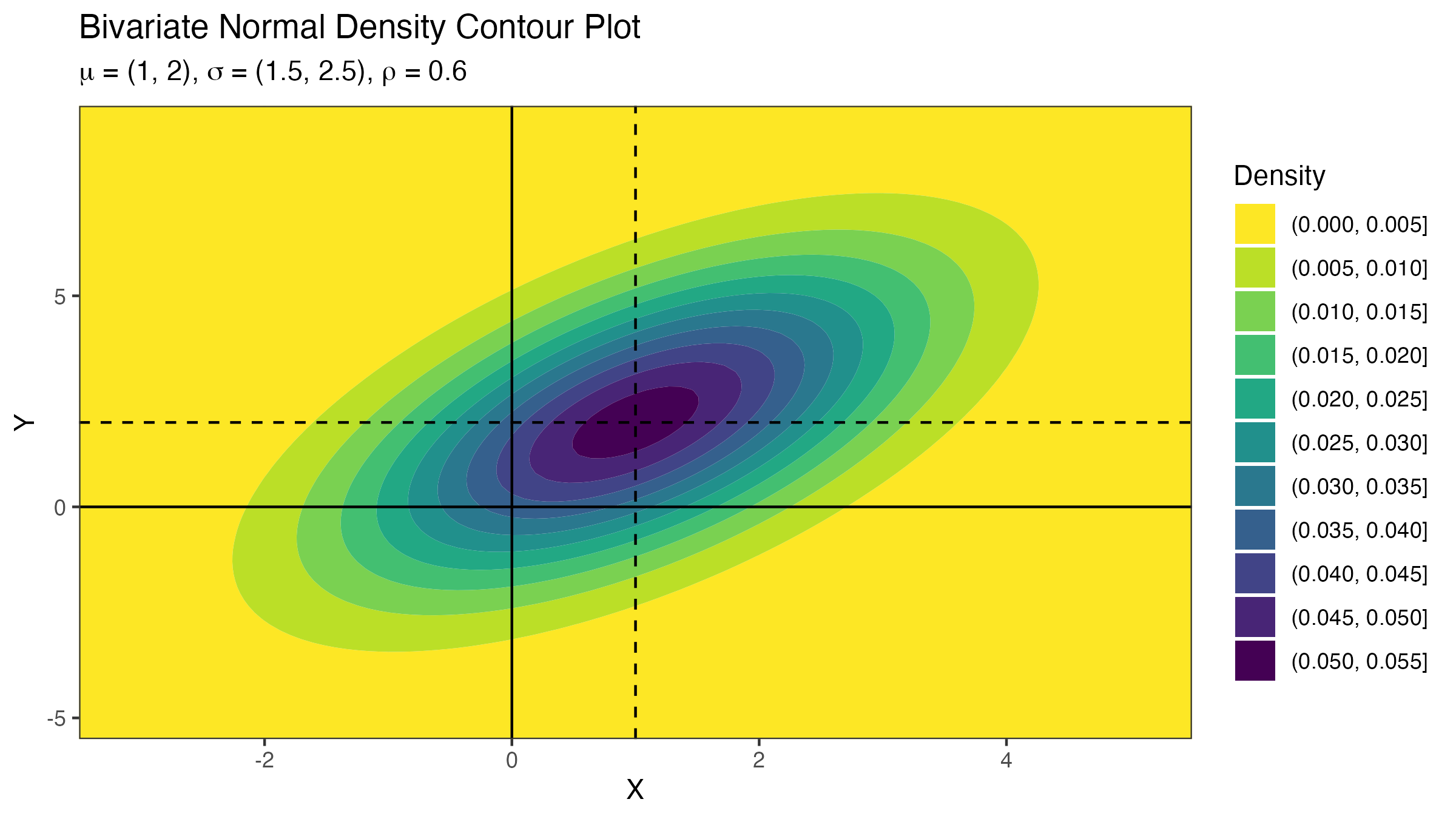
Joint uniform distribution
Let \(X\) and \(Y\) be continuous random variables with PDF
\[ f_{X, Y}(x, y) = I_{[0,1]}(x)I_{[0,1]}(y) = I_{[0,1]^2}(x, y). \]
Exercise 6
- Find \(F ( x, y ) = \int_0^x \int_0^y f_{X, Y}(s, t) \mathsf{d}t \mathsf{d}s\) for \(0 \le x, y \le 1\);
- Compute \(F ( 0.3, 0.8 )\) and \(F ( 0.3, 2.1 )\).
- Calculate \(\mathbb{P}( X - 2 Y > 0 )\).
Stat 302 - Winter 2025/26