STAT 406 overview 2026/27 Winter 1

Who am I?

Vivian Meng

TAs

  • Justin Zhang
  • Hasmik Margaryan
  • Daniel Pliego

Who are You?

  • Stats major?
  • Took STAT 306?
  • Took CPSC 340?
  • Feel “knowledgable” about ML?
  • Need this course to graduate?

This Course

Goal:

  • Develop deep statistical intuitions about prediction and learning
  • Draw connections between modelling/learning paradigms

Assumptions:

  • You have familiarity with linear models (STAT 306) or ML basics (CPSC 340)
  • You are willing to put in the work!

Differences from Prior Courses


If You’ve Taken STAT306

  • Risks analyses
  • High dimensional learning methods
  • Non-linear learning methods
  • Non-parametric learning methods
  • Unsupervised learning methods
  • “Modern” methods (deep learning/ensembles)

If You’ve Taken CPSC340

  • Surface level: mostly same content
  • Under the hood: more depth/stats
    • Statistical modelling/model selection
    • Bias-variance tradeoff
    • Curse of dimensionality
    • Black-box computational methods
    • Generative versus discrminative modelling

Course Content and Learning Outcomes

What is Statistical Learning?

A history lesson

Early AI, Summers, and Winters

  • 1950s: “intelligent machines”, Turing test
  • 1960s-80s: Early perceptrons, rule-based systems, hype cycles
  • 1970s-80s: AI winter(s)

What is Statistical Learning?

Meanwhile, in Statistics Land…

Statisticians are developing frameworks for reasoning, predicting, and making decision from data.

  • 1800s (Legendre and Gauss): predicting form data (least squares)
  • 1910s (Fisher): estimating unknown parameters (MLE)
  • 1940s (Shannon): quantifying information in data (information theory)
  • 1950s (Wald): making decisions from data (decision theory)
  • 1970s-80s: blackbox computer-based algorithms (bootstrap, MCMC)

🧐 Aren’t these the same goals that the AI community has? 🧐

What is Statistical Learning?

Statistians Guide AI

  • 1980s (Vapnik, Chervonenkis): statistical learning theory
    • Study learning general knowledge from data
    • Mathematical formalism for when learning is possible
  • 1990s-2000s: new algorithms based on stats
    • Support vector machines
    • Bagging/random forests
    • Topic modelling
  • Applications in the new internet economy (search, ads, product recommendations)
  • AI \(\rightarrow\) machine learning

What is Statistical Learning?

Statisticians Play Catch-Up

  • 2010s: deep learning revolution
    • Stats: ideas as “unprincipled”
    • CS: see lots of empirical success
  • 2020s: generative AI
    • Breakthroughs come from scale (more data, more compute)
    • Big gap between theory and practice
    • Core ideas are stat. learning principles

Course Learning Outcomes

  1. Formulate and analyze machine learning algorithms from a statistical perspective
  2. Categorize learning methods through multiple criteria
  3. Draw connections between any two learning algorithms and paradigms
  4. Reason about which methods are most appropriate for a given situation
  5. Apply these methods correctly, troubleshoot common pitfalls, and identify probable steps for improving
  6. Implement and utilize models in R using best coding practices

6 Modules

Each module has a technical content theme (and a statistical principles theme)

  1. Basic regression/classification (statistical modelling/selection)
  2. Linear methods, regularization, featurization (bias-variance tradeoff)
  3. Nonparametric methods (curse of dimensionality)
  4. Unsupervised learning (generative vs. discriminative modelling)
  5. Ensembles (black-box methods)
  6. Deep learning

Logistics / Syllabus

Course Components

  1. In-Class (discussion, mathematical derivations)
  2. Labs (coding, tools, how-tos)
  3. Homework Assignments (synthesis, debugging, analysis)
  4. Exams (all of the above)

Grading Structure

Knowledge Based (42 points)

Component Points
Midterm 12 points
Final 30 points
Total 42 points

Effort Based (58 points)

Component Points
Clickers 10 points
Labs 18 points
Homework 40 points
Total 58 points

🧐 10 + 18 + 40 > 58??? 🧐

Component Points
Clickers 10 points
Labs 18 points
Homework 40 points
Total 58 points

\[\text{effort} = \min\left\{58, \text{clickers} + \text{lab} + \text{hw}\right\}\]

Get 58 of the 68 total points any way you want

  • Skip class + perfect on labs/homework = 58 points
  • Miss 1 homework + get in-class points = 58 points
  • (More on this later)

In-Class

Class Structure

  • Lecture: I’ll go over content
  • Derivations: You’ll do math in groups
  • Discussions: We’ll analyze content together
  • Clickers: You’ll apply your knowledge (in pairs)


Important

8am is hard.

Attendance is optional.

Reasons to Skip Class

  1. If you’re sleep deprived
    Getting more sleep may be beneficial to your learning in the long run

  2. If you’re not going to engage/participate

  3. If you’re going to have your laptop open
    Do your homework/social media browsing/k-pop video watching in the comfort of your own home; then revisit the course material on your own time

Reasons to Attend Class (without Distractions)

1. Time to Think/Digest/Struggle with the Material

  • Developing deep intuitions takes time/effort.
  • Class gives you 3 hours/week to chew on the material.
  • I’ll pace the material accordingly

Reasons to Attend Class (without Distractions)

2. In-Class is Where We Wrestle with Math

  • There is lots of math in the course
  • We will spend time in class working through derivations together
  • Working through derivations builds intuitions and deep knowledge
  • Few opportunities on labs/homeworks for this kind of work

Reasons to Attend Class (without Distractions)

3. Questions and Discussions

  • There’s plenty of online materials that teach you this content (books, videos, etc)
  • There’s few opportunities to discuss content with peers/experts
  • If you’re graduating this year, this course may be one of your last opportunities for this type of learning!

Reasons to Attend Class (without Distractions)

4. Effort-Based Points

  • If you skip class, you’ll need to get a perfect grade on labs/homeworks to get a maximum effort-based grade
  • If you attend class, you can miss a few clicker questions, mess up on a homework, and still get a perfect grade!

Reasons to Attend Class (without Distractions)

5. Recommendation Letters

What I Write for Students who Attend/Participate/Ask Questions
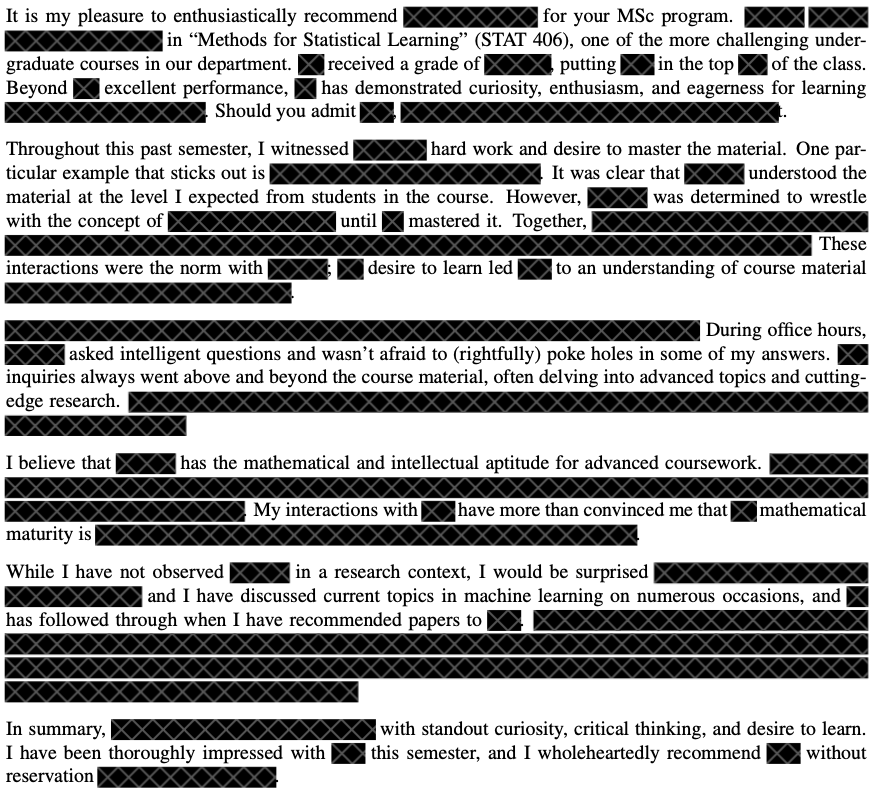
What I Write for Students who Just “Show Up”

I don’t get to know you, so all I can talk about is your grade.

TLDR

  • Waking up early, avoiding distractions, and participating is hard
  • If you don’t have the energy or mental bandwidth on any given day, give yourself the gift of staying home.
  • If you come in, be prepared to engage and put in effort.

Earning Points

Clickers (10 points)

  • We will use iClicker for questions that are similar to the midterm/final
  • I will tally up all the clicker points at the end of term, give people some slack for missing 15% of questions, and assign you a clicker grade from 0-10.
  • Make sure you include your Student ID in your iClicker student profile.

Labs / Assignments

Mechanics and Grading

The goal is to “Do the work”

Labs

  • Labs should give you practice, allow for questions with the TAs.

  • They are due at 2359 on Saturday, lightly graded.

  • You may do them at home, but you must submit individually

  • Labs are lightly graded (complete nonsense/ reasonable effort/ mostly correct)

Assignments

  • Not easy, especially the first 2, especially if you are unfamiliar with R / Rmarkdown / ggplot

  • Don’t leave these for the last minute. I will post the assignments early and the due dates have already been scheduled.

Tools: R, Rmarkdown, LaTex

  • Language/Libraries: R + Tidyverse

  • Submission: on Canvas

Important

We assume you’re familiar with these tools (R, Tidyverse)

If you’re not, it’s your responsibility to get up-to-speed with them.

See Canvas for tutorials / the website for resources.

Workflow

  • For each lab or assignment you will be given a template .Rmd file that you will fill-out and knit into a pretty pdf file for submission.

  • You will learn about this process in lab00 next week

  • Submit both .Rmd and .pdf file on Canvas.

Generative AI Policy

  • AI tools are quite capable with this material
  • Strong recommendation: Use AI as little as possible to maximize learning
  • If you use AI, use it to supplement your thinking (code completion, rewriting) not replace your thinking (feeding entire assignments to chatbots)

Why Minimize AI Use?

  1. Deep intuitions require struggle
    The only way to develop intuitions about challenging material is to wrestle with content

  2. Stand out from the crowd
    Anyone can use Claude/Copilot for simple ML. Demonstrate thinking beyond these tools will make you more hireable/trusted

  3. Course-specific subtleties
    Even with good prompting, chatbots likely won’t score above 7-8 on assignments

  4. No AI on exams
    Don’t become too dependent on tools you can’t use during midterm/final

If you Use Generative AI…


Self-reporting required:

  • Describe your AI usage on all assignments and labs.
  • Include all prompts you use.
  • Please be honest (it’ll help me improve the course/your learning experience)
  • No grade penalty

Late policy

No late assignments accepted, but if you are late by a little … it’s fine.


When you submit Likelihood that your submission gets a 0
Before 11:59pm on due date (i.e. on time) 0%
11:01pm on due date 0.001%
9am after due date 0.1%
2 days after due date 99.99999999%


Exception: when you have grounds for academic consession. (See the UBC policy.)

Tip

Remember: you can still get a “perfect” effort grade even if you get a 0 on one assignment.

Reading/Textbook

Lecture Notes

Lecture Notes (Primary Reading)

Prof. Geoff Pleiss wrote detailed lecture notes for every class.

I strongly recommend reading them before class.
No quizzes/knowledge demonstration/accountability for not reading, but please do!

Reading before class will improve your preparation and ability to engage.

Optional Textbooks

An Introduction to Statistical Learning

James, Witten, Hastie, Tibshirani, 2013, Springer, New York. (denoted [ISLR])

Available free online: http://statlearning.com/

The Elements of Statistical Learning

Hastie, Tibshirani, Friedman, 2009, Second Edition, Springer, New York. (denoted [ESL])

Also available free online: https://web.stanford.edu/~hastie/ElemStatLearn/

  • The schedule lists optional readings from these textbooks for each lecture
  • [ESL] is more advanced — optional and supplemental throughout

Knowledge-Based Assessment

Exams

Midterm Exam

  • In-class, October 27
  • Computer-based
  • T/F, multiple choice, etc.

Final Exam

  • Scheduled by the university.
  • It is hard
  • The median last year was 65% \(\Rightarrow\) A-
  • Format: TBD


Philosophy

  • If you put in the effort, you’re guaranteed a C+.
  • To get an A+, you need to deeply understand the material.
  • No penalty for skipping the midterm/final.

Time expectations per week:

  • Coming to class – 3 hours

  • Reading the book/lecture notes – 1 hour

  • Labs – 1 hour

  • Homework – 4 hours

  • Study / thinking / playing – 1 hour

Resources

Computer

  • We will use R and we assume some background knowledge.

  • Suggest you use RStudio IDE

  • See https://ubc-stat.github.io/stat-406/ for what you need to install for the whole term.

  • Links to useful supplementary resources are available on the website.

Other Resources

  1. Course website
    All the material (slides, extra worksheets) https://ubc-stat.github.io/stat-406

  2. Piazza
    Discussion board, questions

  • Note that students are expected to help each-other… Explaining things is a good way to consolidate your knowledge! The teaching team will endorse good answers, and chime-in when needed.
  1. Canvas
    Homework / Lab submission

Final Words of Wisdom

  • 8am is hard. But you can do it!
    • I strongly urge you to get up at the same time everyday.
  • If you need help, please ask!
    • I’m here to encourage you, get you un-stuck, and ponder ML mysteries with you
  • Think of this course as preparation for a race/performance/etc.
    • You have to work out/practice, and there’s no shortcuts.
    • Training is hard, but you’ll be pleased with the outcome if you put in the work.
    • We’re here to help you stay excited and motivated on your journey!
  • Join me on a fun exploration of cool material!

Questions?

TODOs

By EOD Tomorrow:

  1. Read the syllabus
  2. Install the R package, read docs, check your LaTeX installation
    BE SURE to follow the Computer Setup instructions on the website!

Before Next Tuesday:

  1. Sign up for Piazza (see Canvas)
  2. Add the correct iClicker course and make sure you provide your Student ID.